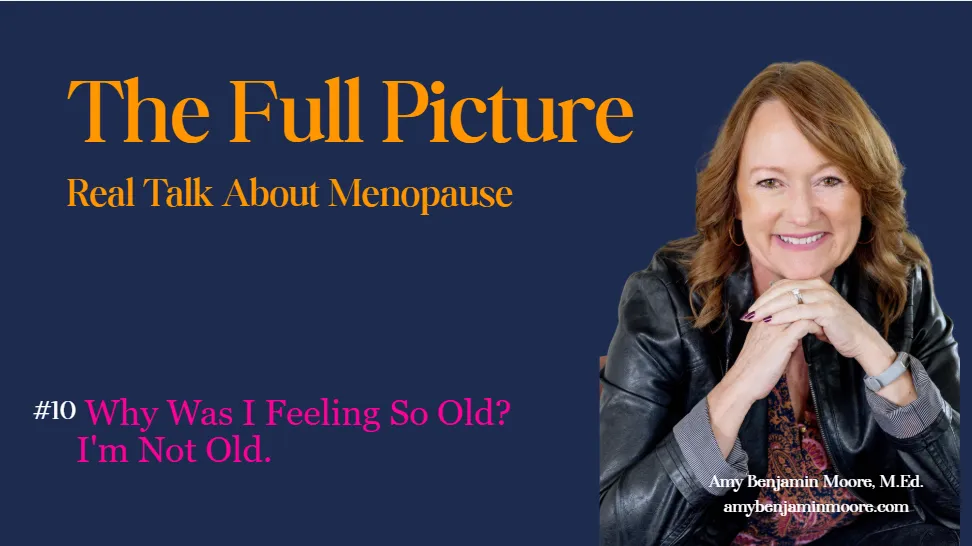
The Full Picture #10: Why Was I Feeling So Old? I'm Not Old.t
Your joints ache in the morning.
Your periods have gotten heavier than they've ever been.
You're forgetting things you would never have forgotten before.
And somewhere in the back of your mind you keep thinking: why do I feel so old? I'm not old.
Welcome to perimenopause. It's one of the most significant transitions of your life, and there's a good chance nobody introduced you to it.
Welcome to perimenopause. It's one of the most significant transitions of your life, and there's a good chance nobody properly introduced you to it.
What's Actually Happening
Perimenopause is the transition phase before menopause, the years when your hormones begin shifting before your periods actually stop. For most women, it starts in their 40s, though it can begin earlier, and it can last anywhere from a few years to over a decade.
So few women recognize it because the symptoms rarely come with a label. Joint pain, heavy or irregular periods, memory lapses, mood changes, sleep disruption, and fatigue- these are the kinds of things women are told to just manage, push through, or accept as part of getting older. They're not. They're hormones.
Menopause is officially diagnosed after 12 consecutive months without a period. Everything before that is perimenopause. That means most women live through it for years without ever being told what it's called.
What This Actually Looked Like For Me
I kept asking myself why I felt the way I did. Joint pain I couldn't explain. Memory lapses that were rattling me. My periods getting heavier in a way that felt wrong. And then frozen shoulder. I had no idea what was happening to my body, and not once did anyone connect it to perimenopause.
I wasn't falling apart. I wasn't just getting older. I was in perimenopause, and nobody gave me that piece of information. I had to find it on my own, much later than I should have.
If you've been chalking things up to age, to stress, to just life, I want you to consider that there might be a different explanation. One that actually has a name.
What the Research Says
Research on perimenopause onset consistently shows that the hormonal shifts of this transition begin years before periods stop, with estrogen and progesterone starting to fluctuate irregularly in most women during their mid to late 40s, though onset in the early 40s or even late 30s is well documented.
Studies on symptom recognition during perimenopause have found that the majority of women do not connect their physical symptoms to hormonal changes, largely because healthcare providers often fail to discuss the perimenopause transition proactively, leaving women to self-identify and self-advocate.
Perimenopause isn't the beginning of the end. It's the beginning of a transition you deserve to understand.
Three Shifts That Actually Help
Write down every symptom you've been dismissing as just getting older. Joint pain, period changes, memory, mood, sleep- all of it. You may be looking at a perimenopause symptom list without realizing it.
Find out your family history on menopause. When your mother or older sisters went through it and how it showed up for them gives you real context for your own timeline. Don't be surprised if they don't really know their own history.
Start tracking your cycle if you aren't already. Changes in length, flow, and regularity are often the earliest concrete signals that the transition has begun.
Your Move
We all got the puberty talk. Someone sat us down and explained what was coming. Nobody did that for perimenopause, and that gap is exactly why Hot Flashes & Cold Truths: A No-Nonsense Guide to Menopause exists. It's the manual we never got, with a side of sass.
Hot Flashes & Cold Truths: A No-Nonsense Guide to Menopause: https://amzn.to/4hNLXvQ
You're not crazy. You were never given the full picture.
This post is for educational purposes only and is not a substitute for professional medical advice. Always consult your healthcare provider about your specific situation.