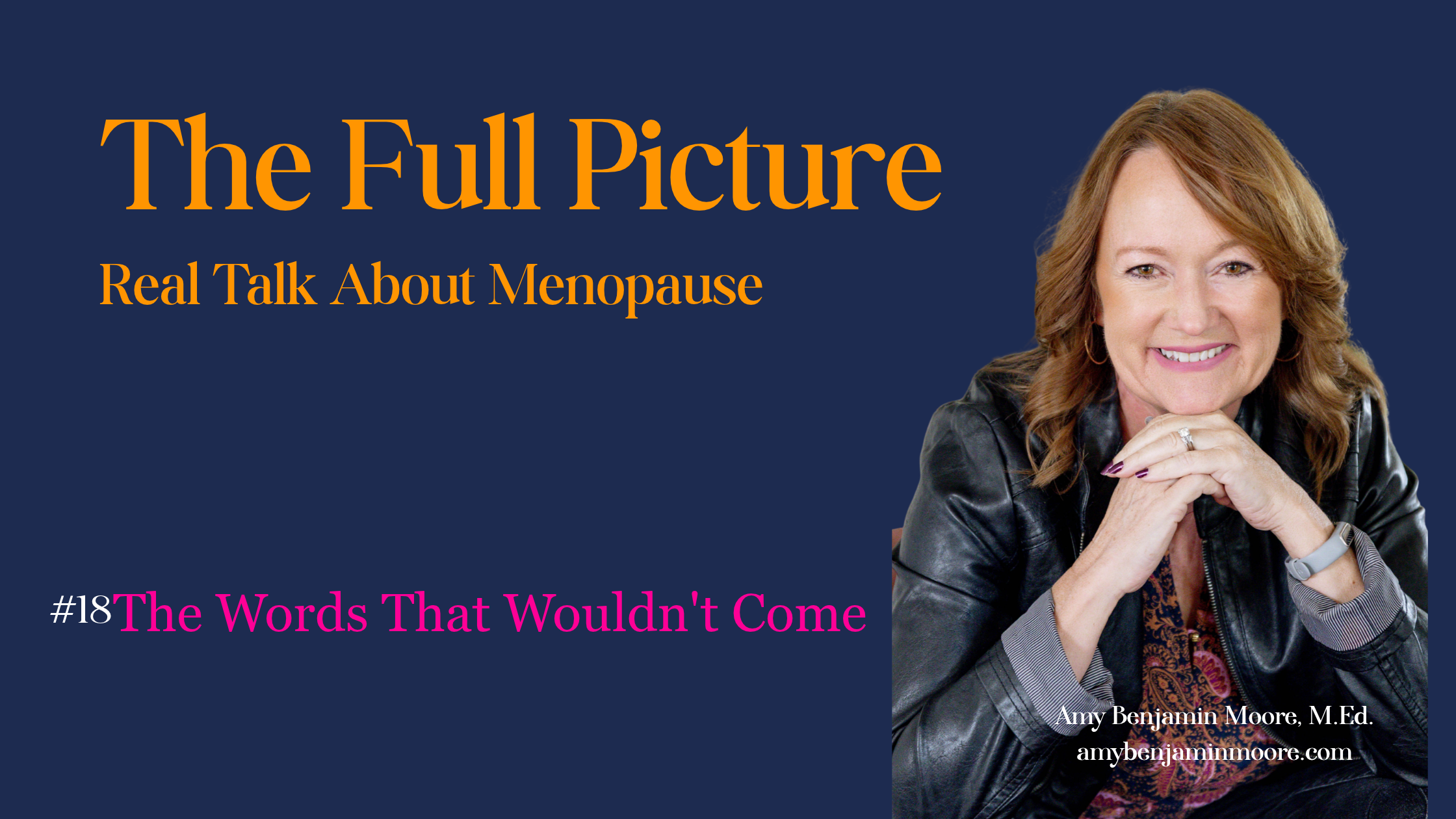
The Full Picture #18: Menopause Brain Fog: Forgetting Words and Names at Work
You're mid-sentence. Everyone is looking at you.
And the word you need just... leaves the building.
Not a hard word. A normal word. One you've used a thousand times.
So you say "the thingy" and hope nobody noticed.
They probably didn't. But you did. And it rattled you.
Here's what nobody tells you: there's a real reason this happens, and it has nothing to do with losing your edge.
What's Actually Happening
Estrogen does a lot more than run your cycle. Your brain is full of estrogen receptors, especially in the areas that handle memory and language, like the hippocampus. Think of the hippocampus as your brain's filing clerk, the part that stores information and pulls it back out when you need it.
During perimenopause, estrogen doesn't decline in a smooth, gentle slope. It swings. High one week, low the next. Your brain has spent decades running on a fairly predictable supply, and suddenly that supply is unreliable. The filing clerk is still on the job. Some days the clerk is just slow.
That's why this symptom feels so specific. It's usually not "I forgot how to do my job." It's retrieval. The information is in there. Pulling it out on demand is what gets harder. Names. Nouns. The word sitting right on the tip of your tongue that shows up two minutes after the meeting ends.
And work is where it shows up most, because work is where you're expected to be quick, polished and on.
What This Actually Looked Like For Me
Memory was one of the symptoms I feared most at work. Names had never been a problem for me. Then suddenly I'd be face to face with someone I knew and come up completely empty.
And word-finding? That one could be downright embarrassing. I'd be mid-sentence, reach for a word I've used my whole life, and get nothing. I worried people would notice. I worried about what it meant.
What the Research Says
The Study of Women's Health Across the Nation (SWAN), one of the largest long-term studies of women in midlife, followed thousands of women through the menopause transition. It found that verbal memory and processing speed can dip during perimenopause. The encouraging part: for many women, performance improved again after the transition. This is a phase, not a slide.
Sleep is part of the story too. Night sweats and 3 a.m. wake-ups chip away at the deep sleep your brain uses to lock in memories. Stress adds to it, because when you're worried about forgetting, your brain is busy managing the worry. So if your word-finding is worse after a bad night or in a high-pressure meeting, you're not imagining the pattern.
Brain fog can also have other causes, like thyroid issues, low iron, low B12 or sleep apnea. If memory changes feel severe, get worse quickly or affect your safety, that's a conversation for your doctor.
Forgetting a word is not the same as forgetting how to do your job.
Three Shifts That Actually Help
Buy yourself three seconds. Keep a go-to phrase ready, like "Let me think about the best way to say this." A pause reads as thoughtful instead of stuck, and it gives your brain a moment to catch up.
Describe it, then keep going. If the word won't come, talk around it. "The report we send at the end of the quarter" works just as well. People follow meaning, not vocabulary. The word usually shows up later anyway. Rude, but true.
Front-load names. Before meetings, glance at the attendee list or seating chart. Say names out loud when you greet people. A quick warm-up makes retrieval easier when it counts.
Your Move
If brain fog is the loudest symptom you're dealing with right now, you don't need a 400-page textbook. You need a starting point. My free guide walks you through what's happening in your body and what to do first:
Menopause Survival Guide
https://survival.amybenjaminmoore.com
Hot Flashes & Cold Truths: A No-Nonsense Guide to Menopause is the manual we never got. It explains what your body is doing and why, written for the woman who needs answers in the middle of a sleepless night, not a 400-page textbook.
Hot Flashes & Cold Truths: A No-Nonsense Guide to Menopause: https://amzn.to/4hNLXvQ
You're not crazy. You were never given the full picture.
This post is for educational purposes only and is not a substitute for professional medical advice. Always consult your healthcare provider about your specific situation.